

What Is an Answering Service? How It Works and When to Use One
An answering service is a company or tool that answers your business phone calls when you can’t. It greets callers in your business name, takes messages, answers simple questions, books appointments and passes urgent calls to the right person. Some answering services use live human agents. A newer type uses AI to answer every call.
This guide explains what an answering service is, how a phone answering service works, the main types, the pros and cons, and how to choose one for your business.
What is an answering service?
An answering service is an outside team (or software) that handles your inbound calls for you. Instead of a call going to voicemail, a trained agent or an AI voice picks up, follows a script you agree on, and sends you the details.
Small businesses use answering services when they are too busy to pick up, after hours, on weekends, or when call volume spikes. A plumber on a job, a dentist with a patient in the chair and a real estate agent at a showing all have the same problem: the phone rings and nobody can answer it.
Missed calls cost real money. Many callers will not leave a voicemail and simply call the next business on the list. Use our missed call calculator to estimate what unanswered calls cost you each month.
How does a phone answering service work?
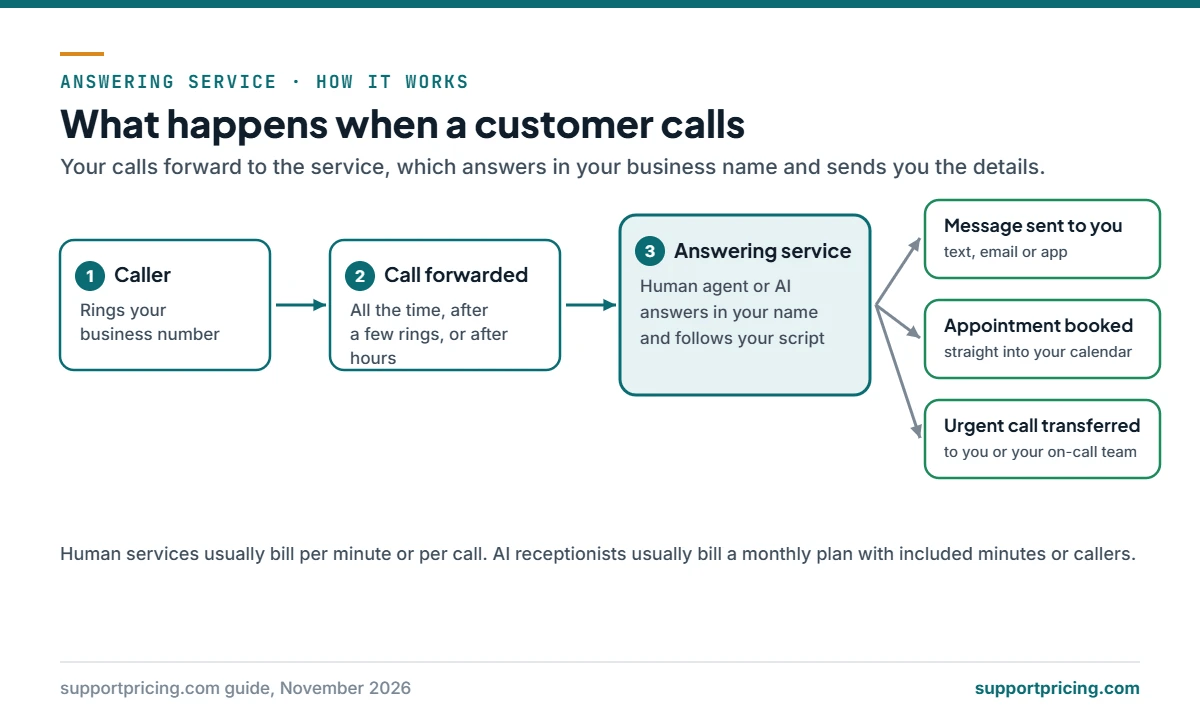
- You forward your calls. You set your business line to forward to the answering service, either all the time, after a set number of rings, or only after hours.
- The service answers in your name. The caller hears your business name, not the answering company’s.
- The agent follows your script. You decide what to ask and what to say. For example: get the caller’s name, number and reason for calling, answer questions about hours and location, and screen for emergencies.
- The call is handled. Depending on your setup, the agent takes a message, books an appointment in your calendar, or transfers the call to you or a team member.
- You get the details. Messages arrive by text, email or app, usually within minutes. Urgent calls can be patched through right away.
Types of answering services
- Live answering service: real people in a call center answer your calls. They are good with unusual or emotional calls but are usually billed by the minute or by the call.
- Virtual receptionist: a live answering service with more front-desk skills, such as booking appointments, qualifying leads and transferring calls.
- After-hours answering service: covers nights, weekends and holidays only, so your own staff handle daytime calls.
- Medical answering service: trained for doctors, clinics and dental offices. It follows patient-privacy rules and routes urgent calls to the on-call provider.
- AI answering service (AI receptionist): software with a natural-sounding voice that answers every call 24/7, answers common questions, books appointments and sends summaries. See our guide to the best AI receptionists for small business.
What can an answering service do?
- Answer calls in your business name, day or night
- Take detailed messages and send them by text or email
- Answer FAQs such as hours, prices, service areas and directions
- Book, change or cancel appointments
- Qualify new leads with a few set questions
- Screen and route emergency calls
- Take overflow calls when your own line is busy
- Answer in more than one language (see bilingual AI receptionists)
Advantages of an answering service
- Fewer missed calls and lost jobs. Every caller reaches someone, so fewer go to a competitor.
- 24/7 coverage without night staff. You can offer round-the-clock service without hiring for every shift.
- Lower cost than a full-time receptionist. You pay for the calls you get, not a full salary and benefits.
- A more professional image. Callers hear a friendly greeting instead of voicemail.
- More focus for you and your team. You stop stopping work every time the phone rings.
- Easy to scale. Busy season, a marketing push or a big storm will not overwhelm your phone line.
Disadvantages to watch for
- Costs can climb. Per-minute and per-call billing adds up fast when call volume grows or calls run long.
- Limited product knowledge. Agents work from a script and cannot answer every detailed question.
- Quality varies. Some services sound rushed or read scripts word for word.
- Setup takes work. You need to write a clear script and keep it updated.
Answering service vs AI receptionist
| Live answering service | AI receptionist | |
|---|---|---|
| Who answers | Human agents in a call center | AI voice software |
| Hours | Set by plan; 24/7 often costs more | 24/7 on every plan |
| Typical pricing | Per minute or per call, set by each provider | Monthly plan with included minutes or callers |
| Busy times | Callers may wait in a queue | Answers many calls at once |
| Best for | Sensitive, complex or emotional calls | FAQs, booking, lead capture and after-hours calls |
AI receptionist plans now start low. As of November 2026, published starting prices include Upfirst at $24.95/month, Dialzara at $29/month (60 minutes), Rosie at $49/month (250 minutes) and Goodcall at $79/month (100 unique callers). Overage fees and limits differ, so compare the full bill for your own call volume with our AI receptionist cost calculator and our AI receptionist pricing guide.
Who uses answering services?
Any business that lives on phone calls can benefit, but some industries depend on them most:
- Home services: plumbers, electricians, roofers and HVAC companies that are on job sites all day. See also AI receptionists for contractors.
- Healthcare: dental offices and medical clinics that need after-hours coverage.
- Real estate: agents who miss calls during showings. See AI receptionists for real estate.
- Law firms, property managers and salons that book appointments and screen new clients by phone.
How to choose an answering service
- Count your calls. Check how many calls you get each month and how long they last. This decides which pricing model is cheaper.
- Decide what the service must do. Messages only, or booking, lead qualification and transfers too?
- Pick human, AI or both. Many businesses use AI for routine calls and a person for complex ones.
- Check integrations. Make sure it connects to your calendar, CRM or booking software.
- Read the fine print. Look for setup fees, minimums, overage rates, holiday fees and contract length.
- Test it. Use a free trial and call your own number several times with different questions.
Frequently asked questions
What is the difference between an answering service and voicemail? Voicemail records a message. An answering service talks to the caller, answers questions, takes structured details and can book appointments or transfer urgent calls.
What is the difference between an answering service and a call center? A call center usually handles high volumes of calls for one company with dedicated agents. An answering service shares agents across many small businesses and handles lower call volumes.
Do answering services work 24/7? Many do, but some charge more for nights, weekends and holidays. AI receptionists answer 24/7 on every plan.
Can an answering service book appointments? Yes. Most virtual receptionists and AI receptionists can add bookings straight to your calendar if you connect it.
Is an AI answering service as good as a human? For routine calls such as FAQs, bookings and messages, AI works well and costs less. For sensitive or complex calls, a human is still better. Many businesses use both.


