
What Is a Help Desk? Meaning, Types and How It Works

A help desk is the team, process and software a business uses to answer questions and fix problems for the people it supports. Those people can be customers (a customer help desk) or employees (an IT help desk). Every request comes in through one place, gets tracked, and stays open until someone solves it.
This guide explains what a help desk does, the main types, how help desk support works day to day, and how to choose help desk software without overpaying.
What is a help desk?
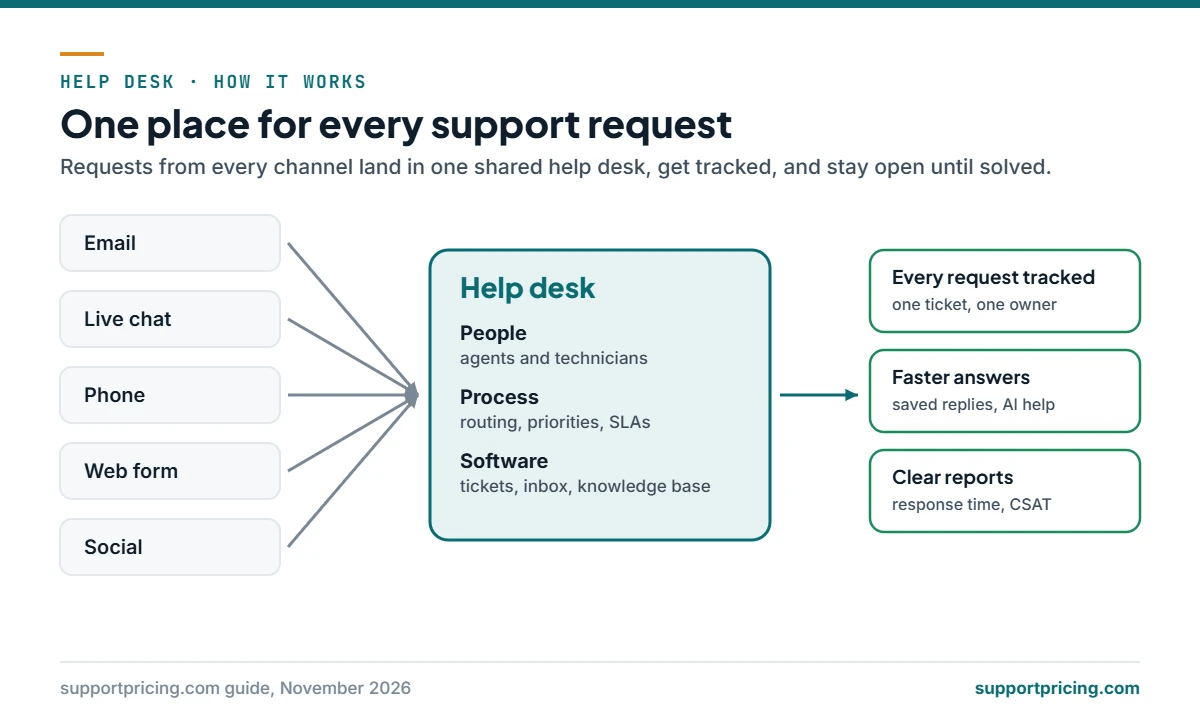
A help desk is a single point of contact for support. Instead of questions arriving scattered across personal inboxes, phone lines and chat apps, they land in one shared system. Each question becomes a ticket with an owner, a status and a history, so nothing gets lost and anyone on the team can see what happened.
The term covers three things that work together:
- People: support agents or technicians who answer requests.
- Process: rules for priority, response targets and when to escalate.
- Software: the tool that collects requests from email, chat, phone and social media and turns them into tickets.
What does help desk support do?
Help desk support handles requests from start to finish. A typical day includes:
- Receiving requests by email, live chat, phone, web forms or social messages.
- Logging and sorting them into tickets, tagged by topic and priority.
- Answering simple questions right away, often with saved replies. See our 30 canned responses.
- Troubleshooting harder problems step by step.
- Escalating what the first line cannot fix to a specialist or developer.
- Closing the loop: confirming the fix with the customer and asking for feedback, usually with a CSAT survey.
Types of help desk
| Type | Who it supports | Typical requests |
|---|---|---|
| Customer help desk | Customers of a product or service | Orders, billing, how-to questions, bugs |
| IT help desk | A company’s own employees | Password resets, laptops, software access, network issues |
| Internal help desk | Employees, for non-IT teams | HR, payroll, facilities and legal questions |
| Outsourced help desk | Either, run by an outside provider | After-hours cover, overflow, first-line support |
What is an IT help desk?
An IT help desk supports a company’s own staff with technology problems: locked accounts, broken laptops, printer errors, VPN issues and software requests. It usually works in tiers:
- Tier 1: common issues with known fixes, such as password resets.
- Tier 2: deeper troubleshooting by more experienced technicians.
- Tier 3: specialists, engineers or the vendor.
Larger IT teams often follow ITIL, a framework of good practice for IT service management, and call their help desk a service desk.
Help desk vs service desk
The two terms are often used as if they mean the same thing. When people do draw a line, it looks like this:
| Help desk | Service desk | |
|---|---|---|
| Focus | Fixing problems as they come in | Managing all IT services end to end |
| Scope | Incidents and questions | Incidents, requests, changes, assets and more |
| Typical user | Small and mid-size teams, customer support | Larger IT departments using ITIL |
For a small business answering customer questions, “help desk” is the right term, and help desk software is the right tool.
What does a help desk technician do?
A help desk technician (or support agent) is the first person to handle a request. The job is to understand the problem quickly, fix what can be fixed on the first contact, and hand off the rest with clear notes. Useful skills include clear writing, patience, basic troubleshooting, knowledge of the product or systems being supported, and good habits with the ticketing tool.
Two numbers show how well a help desk works: how fast people get a first reply, and how happy they are afterwards. Measure them with our first response time calculator and CSAT calculator.
What is help desk software?
Help desk software collects requests from every channel into one shared inbox and turns them into tickets. Common features:
- Ticketing: assign, prioritise, tag and track every request.
- Shared inbox: email, chat, social and sometimes phone in one view.
- Knowledge base: help articles customers can read on their own, which reduces tickets. See ticket deflection.
- Automation: routing rules, saved replies and SLA reminders.
- Reporting: volume, response times and satisfaction.
- AI: AI agents that answer simple questions, plus AI that drafts replies for agents.
Popular options include Zendesk, Freshdesk, Help Scout, Intercom, Zoho Desk and Gorgias. Open-source tools such as Zammad, osTicket, FreeScout, Chatwoot and Helpin can be self-hosted with no licence fee. Compare them in our best AI helpdesk software guide and open-source ticketing systems list.
How much does help desk software cost?
Most help desks charge per agent per month, plus a separate fee for AI. As of November 2026, entry plans on vendors’ own pricing pages start around $19 per agent per month (annual billing) for Zendesk and Freshdesk and $25 per user for Help Scout, which also has a free plan. AI is usually billed per resolution, for example $0.75 at Help Scout and $0.99 at Intercom. See every AI rate side by side in our AI resolution cost comparison.
The real bill depends on your team size and how much the AI does. Our helpdesk cost calculator adds seats and AI fees together for six tools.
How to choose help desk software
- List your channels. Email only, or chat, social and phone too?
- Count your agents and monthly tickets. These two numbers drive most of the cost.
- Decide how much AI you want. Per-resolution AI fees can cost more than seats at higher volumes.
- Check integrations with your CRM, store or billing tool.
- Test with real tickets during a free trial before you commit.
- Think about data control. If you need to keep data in-house, look at self-hosted open-source options.
Frequently asked questions
What is the difference between a help desk and customer service? Customer service is the whole experience of helping customers. A help desk is the system and team that handles their individual questions and problems.
Is a help desk the same as a call center? No. A call center is built around phone calls. A help desk handles requests across many channels and tracks each one as a ticket.
Do small businesses need a help desk? Once more than one person answers customer emails, a shared help desk stops questions slipping through the cracks. Several tools have free plans for small teams.
What is a ticketing system? It is the part of help desk software that turns each request into a trackable ticket with an owner and a status.
Related: Best AI helpdesk software · Zendesk alternatives · Helpdesk cost calculator


